The design has changed. Who checks the calculations?
When dimensions or material properties change on site, updating a calculation sheet can involve much more than replacing one number. Design provisions must be checked, loads recombined, and intermediate results carried into later calculations. A small mistake can travel through the entire sequence.
Could an AI assistant redo those checks? A convincing explanation is not necessarily a correct structural calculation. Even with the right reference document, an incorrect formula or a mix-up between meters and millimeters can invalidate the answer.
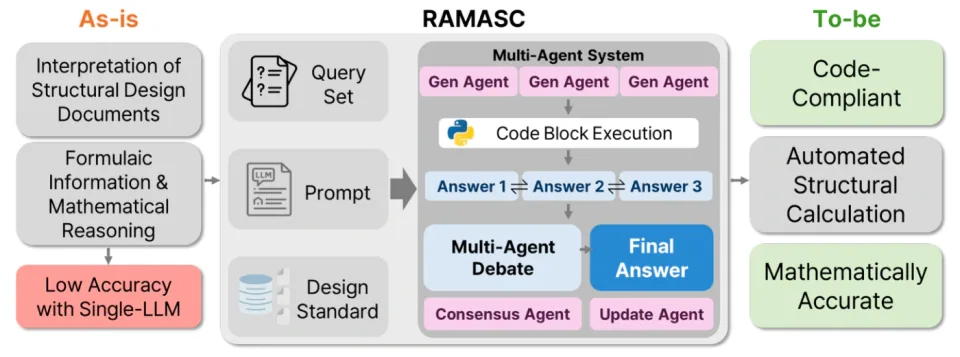
RAMASC tackles this challenge by connecting three capabilities: retrieving design provisions, executing Python calculations, and comparing answers from multiple AI agents. Its central idea is to organize finding, calculating, and reviewing into a connected workflow.
1. Giving AI a codebook is only the beginning
Retrieval-augmented generation, or RAG, lets an AI consult relevant documents before answering. Think of an open-book examination rather than a test of memory.
An open book does not solve the problem by itself. The right formula must be selected, its conditions understood, and its arithmetic performed correctly. Structural calculations are especially demanding because one answer often becomes an input to the next.
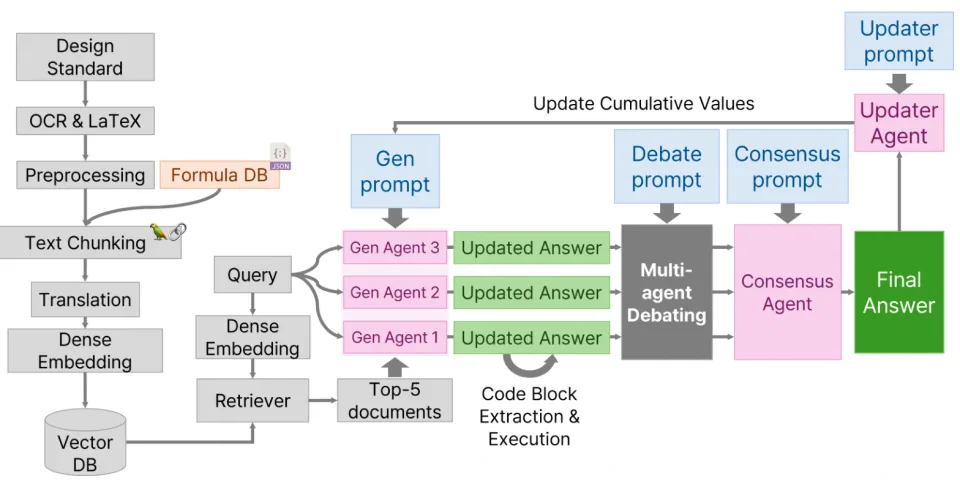
RAMASC supplements design documents with an expert-curated formula database, including equations, variable definitions, and units. The slab experiments used 20 manually prepared and validated equations. This is not a system where uploading any PDF immediately enables calculations for any structure. Reliable source preparation is part of the work.
2. Retrieve the reference, run the calculation, compare the answers
The process resembles a small team with a shared calculation task.
| Stage | What happens | Why it helps |
|---|---|---|
| Retrieve | Find relevant design provisions and formulas | Ground the response in reference material |
| Execute | Run AI-generated Python code externally | Perform arithmetic rather than predict a numerical answer as text |
| Review | Three agents compare and revise their responses | Examine disagreements in formulas and reasoning |
| Carry forward | Preserve key values from the agreed answer | Keep later calculations consistent with earlier steps |
The three agents are not three unrelated commercial models. The experiment used the same GPT-4o model with different generation settings. Each produced an answer before reviewing peer responses against the retrieved material.
3. What changed in the experiments?
The researchers evaluated precast concrete floor panels and inverted T-type retaining walls. Slab questions covered tasks such as minimum thickness, load combinations, and bending and shear checks. Retaining walls introduced earth pressures and checks for overturning, sliding, and bearing capacity.
Each structural task used 50 sequential calculation questions. The following results compare selected configurations for Case 1 of each task.
| Configuration | Slab accuracy | Retaining wall accuracy |
|---|---|---|
| RAG only | 40% | 40% |
| RAG + formula database + code execution | 62% | 72% |
| RAG + formula database + agent debate | 52% | 42% |
| Full RAMASC: retrieval + formulas + execution + debate | 96% | 94% |
Selected configurations from Tables 2 and 6 of the paper. See the original for the complete comparison.
The striking result is that execution and review worked better together than debate alone. Arithmetic execution and checking the logic across steps address different problems. This finding is specific to these experiments; it does not establish the same benefit for every AI task.
Across four slab parameter cases, average accuracy was 95.5%. Across three retaining-wall heights, it was 91.3%. The retaining-wall study used a new domain-specific formula database and reference corpus while retaining the core architecture.
These percentages are not probabilities that an entire structure is safe. Answers were evaluated against expert-validated reference calculations, requiring numerical agreement within 0.1% relative error and consistency in the applied formula and load-combination logic.
4. The calculation trail matters as much as the answer
One example in the paper brings the question, retrieved provision, Python code, and execution result together. It checks minimum slab thickness under a particular set of conditions.
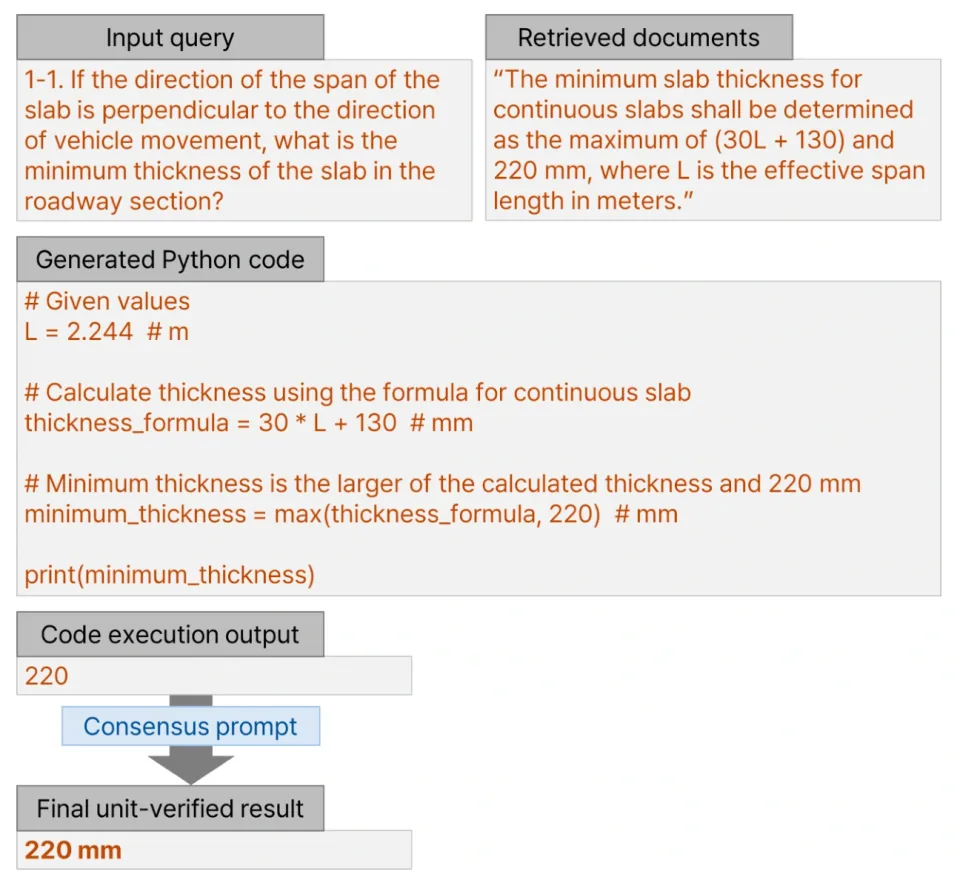
A useful engineering assistant should expose the reference, assumptions, units, and executed calculation—not simply return a number. That makes its work inspectable and helps an engineer locate a mistake.
5. Agreement among agents can still be wrong
The paper reports a case where two agents shared an incorrect intermediate assumption and their answer prevailed over a correct minority response. Agreement is not proof. Agents using similar models and inputs can make correlated mistakes.
Unit handling also remained a source of errors. Code may run successfully while using a unit convention that does not match the formula or the required output. Executable arithmetic is not the same as an engineering-valid calculation.
The results therefore do not justify removing an engineer's final review. Practical use still requires checking the applicable code edition, loads, boundary conditions, and units, with independent calculation where appropriate. Stronger unit handling and explicit validation rules remain areas for future development.
6. Where could this be useful in practice?
The promising direction is assistance with repetitive, code-based calculation and review: updating familiar checks when parameters change and organizing the references and calculation steps for inspection. The study does not directly establish time savings in commercial site workflows.
Speed and cost also matter. In the reported environment, processing 50 questions from retrieval through final answer generation took approximately 88 minutes 25 seconds, or about 1 minute 46 seconds per question. Including translation and database preparation, the full experiment took approximately 119 minutes. These are experimental timings, not guaranteed service response times. Multiple agents also increase model usage costs.
RAMASC was not evaluated as a replacement for finite-element software such as MIDAS or SAP2000. Its focus is calculation-sheet-based design-code verification. Connecting it to BIM or digital twins to obtain changed design parameters is an extension proposed in the paper, rather than a demonstrated production integration.
The broader shift is from AI that states an answer to AI that retrieves evidence, executes calculations, and produces inspectable work. For structural engineering, the useful goal is not greater confidence in an answer's wording, but a workflow in which engineers can examine its basis and find its errors.
About the paper
Kichang Choi, Minwoo Jeong, Taegeon Kim, Seokhwan Kim, Seungwon Baek, and Hongjo Kim (2026). RAMASC: A retrieval-augmented multi-agent framework for automated structural calculation. Advanced Engineering Informatics, 74, 104698. Published online April 17, 2026.
About the Author