Research at a glance
- Problem
- General-purpose retrieval can miss the meaning of specialized Korean construction documents.
- Key idea
- Contrastive sentence generation and Matryoshka representations improve domain-specific retrieval.
- Application
- Better evidence retrieval for construction document question answering.
Making AI "Understand" Construction: Introducing RAGO-CONSTRUCT
I am proud to introduce my independent research recently published in Automation in Construction (2026): "Retrieval optimization for construction documents in low-resource languages using contrastive sentence generation and matryoshka representation learning".
Construction engineering relies heavily on massive technical documents. However, general AI models often struggle to understand the specific terminology of the Korean construction industry. This often leads to "hallucinations"—where the AI gives confident but incorrect or misleading answers. To solve this, I developed RAGO-CONSTRUCT, a system designed to help AI find the right information and provide accurate answers to engineers.
The Big Picture: Our Research Framework
To understand how we improved AI's "brain," let’s look at the overall framework of this research.
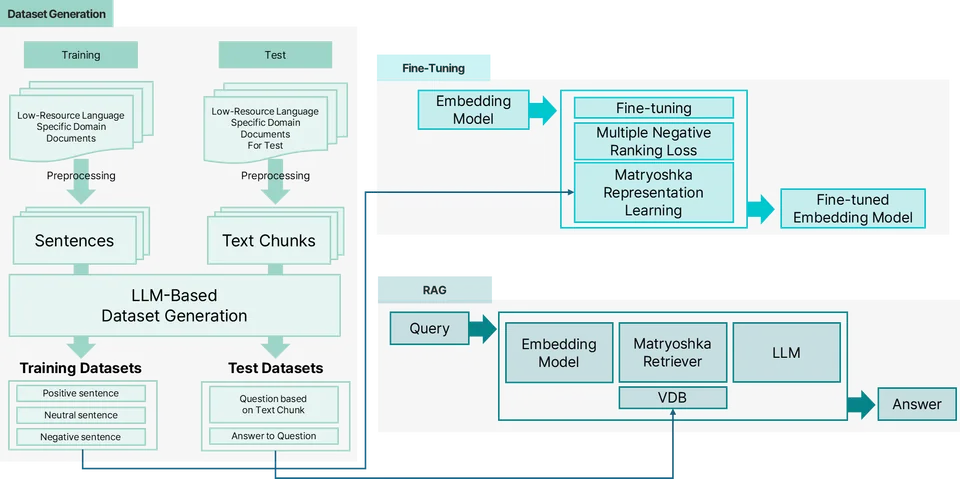
This process involves three main phases:
- Dataset Generation: We collect official construction documents and use a local LLM to turn them into a specialized "study guide".
- Fine-Tuning: We put our embedding model (the part of the AI that reads and searches) through a "boot camp" using this guide.
- RAG (The Final Exam): This is the real-world application where an engineer asks a question, and the AI retrieves the exact document to provide a factual answer.
Step 1: Automatic Study Guides (CSG)
In specialized fields like construction, a single word can have many meanings. To help the AI learn these nuances, I proposed Contrastive Sentence Generation (CSG).
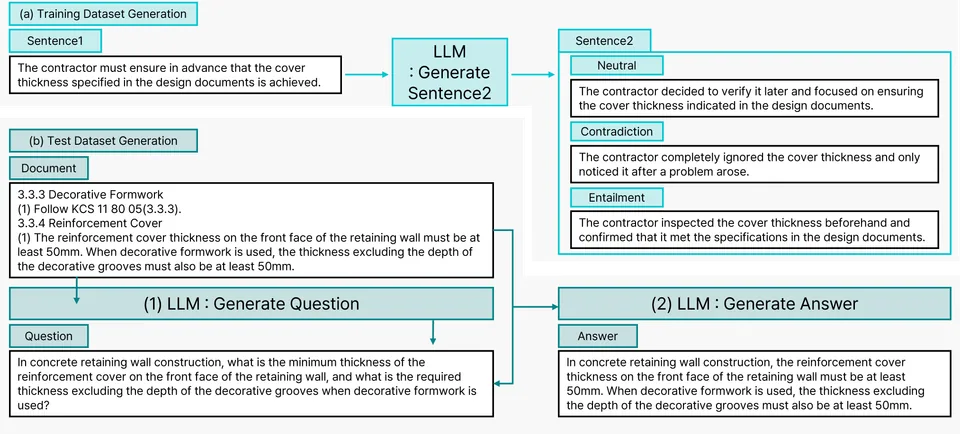
Instead of spending thousands of dollars for experts to manually write training questions, we used a local AI to automatically generate them from official standards:
- Entailment (Positive): A sentence that means the same thing as the original but uses different words.
- Contradiction (Negative): A sentence that looks similar but contains a factual error.
- Neutral: A sentence that is related but doesn't confirm or deny the original fact.
We named this unique dataset KorConNLI. By studying these pairs, the AI learns to distinguish between what is technically correct and what is factually wrong.
Step 2: The "Nesting Doll" Strategy (SBE)
Searching through long documents is hard for AI because specific details often get lost. To fix this, I introduced Sentence Block Embedding (SBE), which works like a Matryoshka (Russian Nesting Doll).
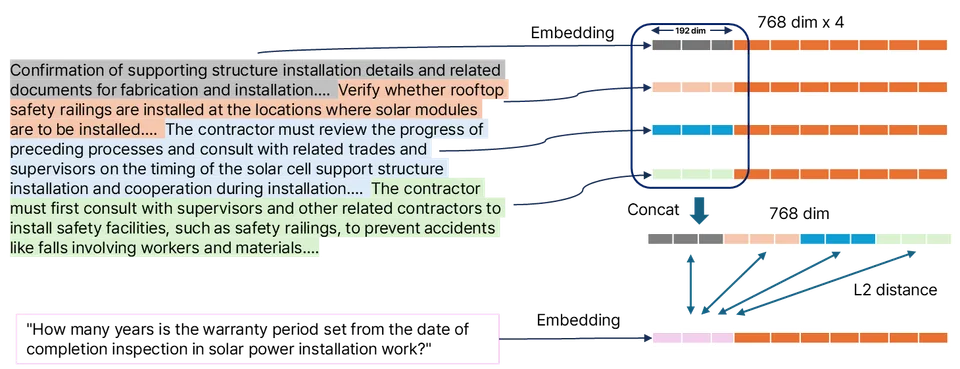
Here is how it works:
- Chop it up: We split a long text chunk into four smaller blocks (128 tokens each).
- Compress: Using Matryoshka Representation Learning (MRL), we organize the most important information into the very beginning of the data vector.
- Concatenate: We take the "best bits" from each block and stitch them together into one efficient vector.
- Pinpoint Search: This allows the AI to search with the precision of short sentences while still providing the full context of the page to the AI for the final answer.
Experimental Results: Outperforming Global Standards
Does this actually work better than standard AI? Yes. I tested RAGO-CONSTRUCT against some of the most powerful AI models available today.
- Higher Accuracy: RAGO-CONSTRUCT achieved 53.7% retrieval accuracy, outperforming OpenAI’s text-embedding-3-large (41.4%) by 12.3 percentage points.
- Better Reasoning: Compared to traditional keyword searches (BM25), our system more than doubled the success rate.
- Reliable Answers: On end-to-end tests, our method improved the overall quality of the AI's answers from 6.9% to 53.5%.
Conclusion
This research provides a practical, low-cost way for the construction industry to adopt AI without needing massive computing power or manual data labeling. By using CSG and SBE, we ensure that when an engineer asks a question, the AI finds the right regulation and gives a safe, accurate answer.
About the Author