Research at a glance
- Problem
- Thin cracks are easily lost or disconnected in segmentation predictions.
- Key idea
- FACS-Net and crack topology loss address frequency information and crack connectivity.
- Application
- More informative crack maps for infrastructure condition assessment.
In this post, I would like to introduce the key findings of my paper, "Frequency-aware crack segmentation network (FACS-net) and crack topology loss (CT-loss) for thin cracks," published in Automation in Construction (Elsevier), 2026.
"Cracks" are among the most critical indicators when diagnosing the safety of construction sites. Detecting early-stage, fine cracks is particularly crucial, yet existing deep learning models have struggled significantly in addressing this challenge.
I identified the root cause of this problem not in data scarcity, but in a structural characteristic of deep learning known as "Spectral Bias." To overcome this, I proposed a new model architecture (FACS-Net) and a loss function (CT-Loss). Through this post, I will share how we solved this difficult problem.
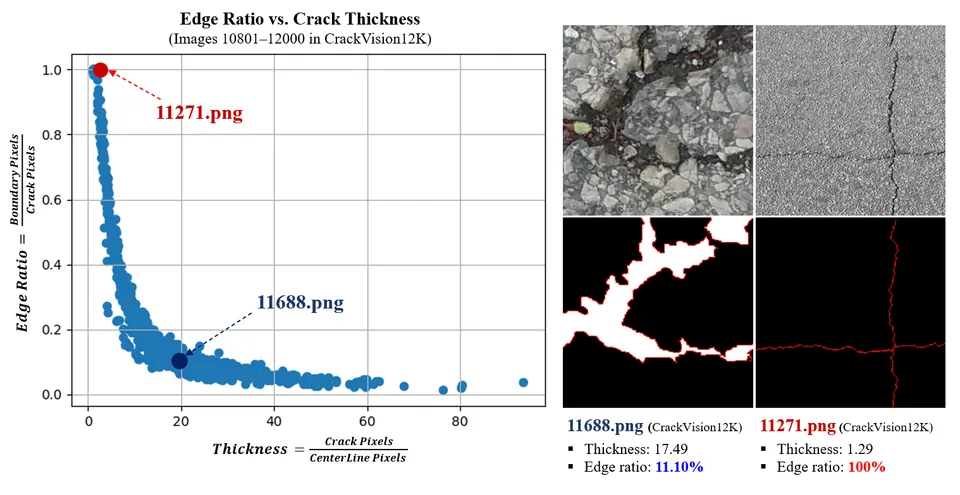
The Origin of the Problem: Why Deep Learning Cannot See Thin Cracks
During the research, the most puzzling observation was that while modern deep learning models are excellent at detecting thick, clear cracks, they become helpless when facing Thin Cracks.
Analyzing this phenomenon revealed that the cause was Spectral Bias, an inherent tendency of deep neural networks.
- Low-frequency: Areas that change smoothly, such as backgrounds or overall shapes. Deep learning models learn these very quickly and well.
- High-frequency: Areas with rapid changes, such as thin cracks, edges, and fine textures. Deep learning models tend to ignore these or delay learning them.
Especially as a crack becomes thinner, the proportion of Edges within the total crack pixels increases dramatically (see Fig. 1 in the paper). However, existing models lose this critical high-frequency information during the down-sampling process in the encoder. Consequently, the model treats fine cracks not as "important signals" but as "background noise."
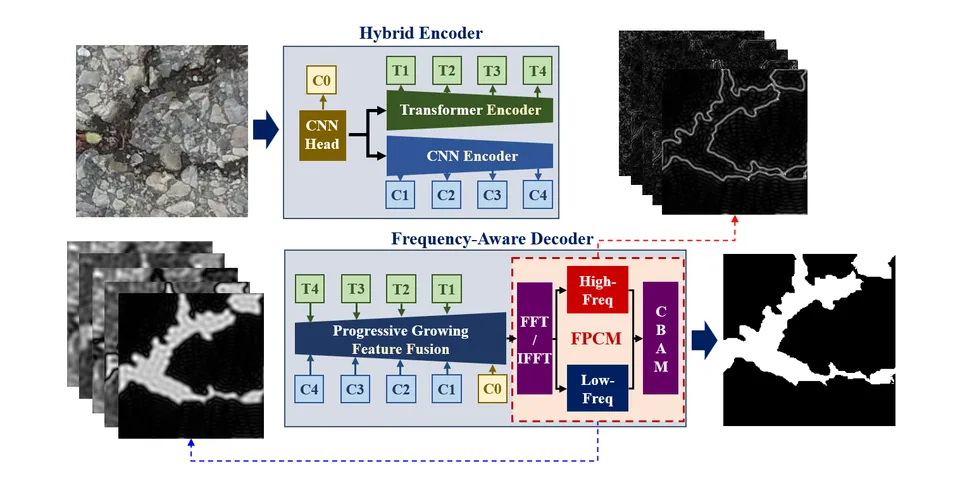
Solution 1: Frequency-Aware Model (FACS-Net)
My approach was simple: "If the model hates seeing high-frequency components, force it to see them." To achieve this, I designed a new architecture called FACS-Net (Frequency-Aware Crack Segmentation Network).
The core innovation is the introduction of the FPCM (Frequency Preference Control Module) into the encoder-decoder structure. This module operates as follows:
- Frequency Decomposition: It converts the image into the frequency domain (via FFT) to separate low-frequency and high-frequency components.
- High-Frequency Emphasis: It applies weights to the high-frequency bands (crack details) that the model tends to miss, ensuring this information is passed to the decoder without loss.
- Progressive Recovery: When upscaling the image from low to high resolution (Progressive Growing), it injects this frequency information at each stage to sharply restore blurred cracks.
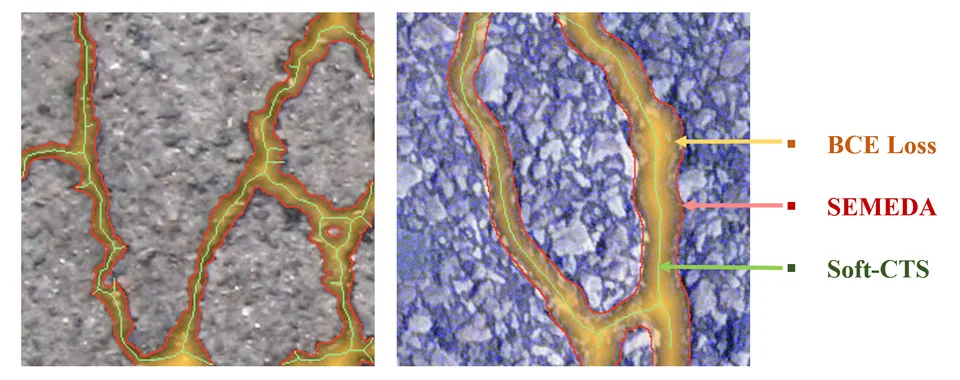
Solution 2: Topology-Preserving Loss Function (CT-Loss)
Even if the model finds the pixels, it is useless for structural diagnosis if the crack is detected as fragmented dots. In safety assessment, understanding the Topology—where a crack starts and how it connects—is essential.
Existing loss functions (like BCE Loss) only check whether individual pixels are correct, leading to the problem where a model is judged as "mostly correct" even if the crack is disconnected.
To solve this, I proposed CT-Loss (Crack Topology Loss), which combines three components:

- BCE Loss: Ensures overall pixel-wise accuracy.
- SEMEDA: Helps maintain sharp Edges of the cracks.
- Soft-CTS: I transformed the CTS (Crack Topology Score) metric, which was previously non-differentiable and thus unusable for training, into a differentiable form (Soft-CTS). This teaches the model that "a broken crack prediction is a wrong prediction."
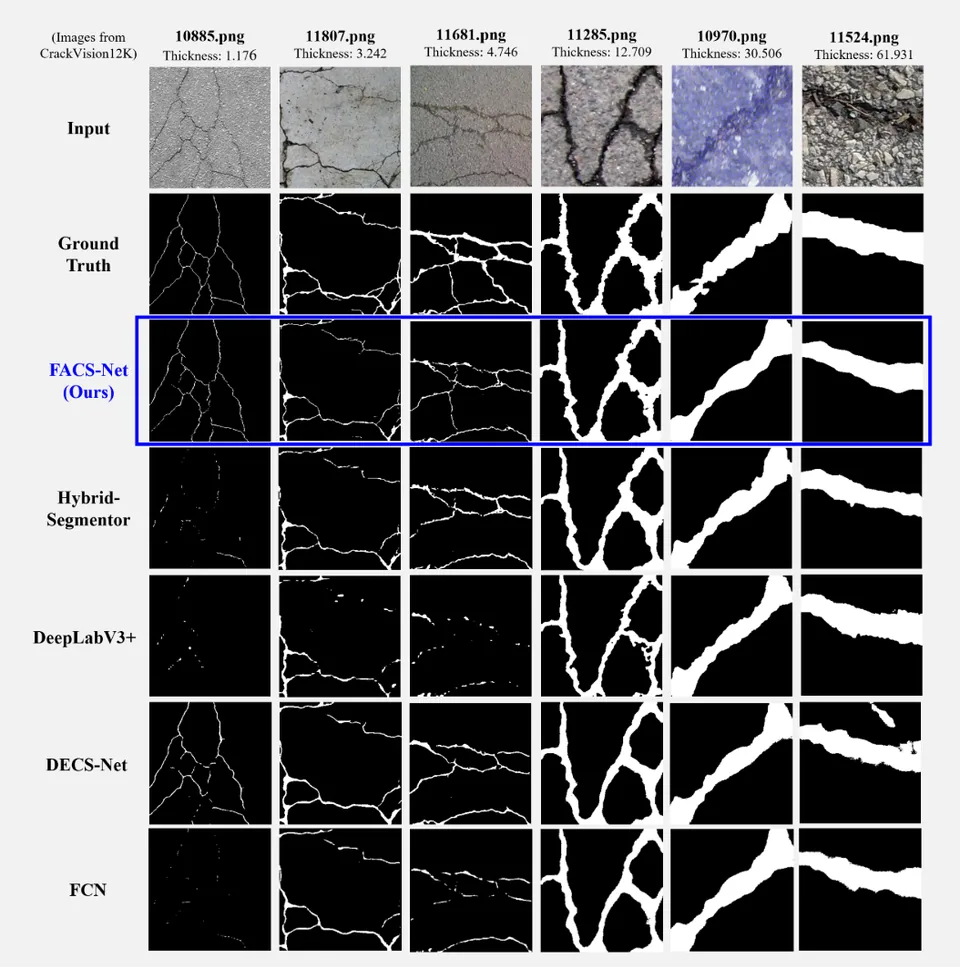
Experimental Results: Overwhelming Improvement on Thin Cracks
Did this idea actually work? Experiments using the large-scale CrackVision12K dataset confirmed remarkable performance improvements, especially on extremely thin cracks (less than 2 pixels wide).
Compared to the existing SOTA model (Hybrid-Segmentor):
- IoU (Intersection over Union): 0.160 → 0.466 (Approx. 3x improvement).
- CTS (Topology Score): 0.585 → 0.945 (Detected smoothly without fragmentation).
While other models recognized fine cracks as noise or detected them as dotted lines, FACS-Net successfully identified them as continuous solid lines.
Closing Remarks
This research goes beyond simply improving model performance; it is the result of deep contemplation on how to teach Deep Learning to handle "High-Frequency Domains" and "Topological Connectivity," areas where it has structurally been weak.
I hope that the methodology proposed through FACS-Net and CT-Loss will contribute to various computer vision studies dealing with Thin & Continuous objects, such as power lines, blood vessels, and road networks, in addition to cracks.
About the Author